
The 2025–2030 US Dietary Guidelines for Americans (DGA) were recently released by the US Department of Agriculture.¹ These guidelines are generally updated every five years. However, the latest guidelines have caused significant controversy since their release, due to conflicting recommendations from leading health and nutrition organizations and conflicts of interest with those who made recommendations for the updates.
These nutritional guidelines are meant to serve as general guidelines for adults, with some brief recommendations for different age groups and demographics, like pregnant individuals and older adults.
However, it can be very difficult to navigate your body’s needs, dietary considerations, and individual preferences. Luckily, being informed about the new guidelines and how to navigate them can help you navigate your nutrition with confidence.
What to Know About the New 2025–2030 Dietary Guidelines
The new dietary guidelines depart from the “plate” method that has been used for the past few guideline releases. Instead, the shape has reverted to a pyramid — the shape many people were used to seeing in schools and nutritional guidance years ago. However, this time, the pyramid is upside down, with whole grains at the bottom point. Above that, protein, dairy, and healthy fats on the left, and vegetables and fruits on the right, both extending above the grains to the top.
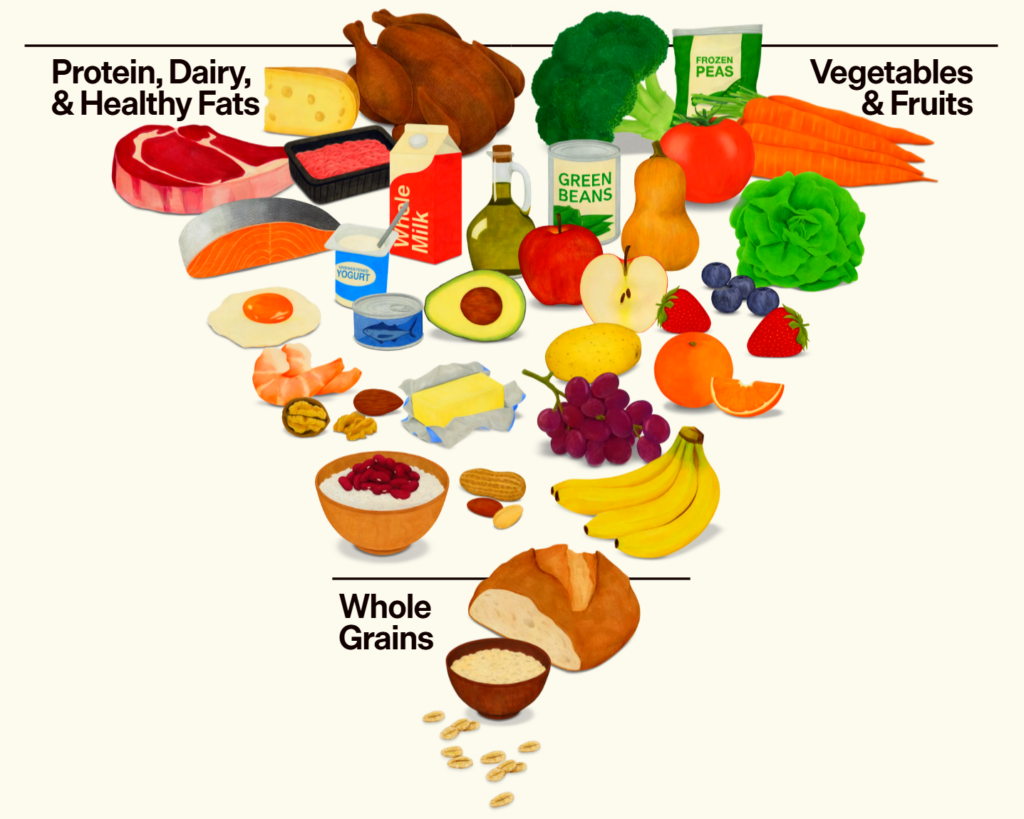
The Academy of Nutrition and Dietetics, the world’s largest organization of food and nutrition professionals, the American Society for Nutrition, the professional organization aimed at bringing together the world’s top researchers, clinical nutritionists, and industry, and numerous other organizations and professionals have expressed concerns with the new guidance.²
This isn’t to say that all experts completely disagree with all the changes; rather, there are concerns about the details of the updates, the evidence (or lack thereof) that the recommendations are rooted in, and the conflicts of interest that could be driving those changes.
For example, the Academy of Nutrition and Dietetics’ dietary guidelines response is aligned with encouraging fruits, vegetables, whole grains, fiber, and microbiome health, among other points.
Here’s a look at some of the key changes, what the USDA (new guidelines) recommends, and what nutrition experts recommend based on decades of longstanding industry research.
| Key Change | USDA Recommendation | Nutrition Expert Recommendation or Concern³ |
| Protein Requirements | “1.2–1.6 grams of
protein per kilogram of body weight per day, adjusting as needed based on your individual caloric requirements” |
Does not consider individual protein needs based on lifestyle and other factors; emphasizes animal-based protein and a complete amino acid profile, which does not account for those who do not eat meat or animal products⁴ |
| Full-Fat Dairy | 3 servings of full-fat dairy a day with no added sugars | Does not consider individuals who cannot or choose not to eat dairy |
| Gut Health | Limiting highly processed foods, emphasizing fruits, vegetables, fermented, and high-fiber foods | More helpful to focus on adding fruits, vegetables, and whole grains, rather than removing specific foods to support gut health |
| Fat Sources | Focus on different fat sources, including recommending prioritizing oils with “essential acids” like olive oils; also suggest butter or beef tallow | New guidelines have contradictory statements on fat, without clear recommendations, both recommending less saturated fats while recommending foods high in saturated fat without clear guides⁵; Academy of Nutrition and Dietetics recommends saturated fat limited to 10% of total daily calories. Additionally, shifts in recent decades have moved American diets away from animal fats and toward vegetable oils as organizations campaigned for heart health, more research is needed to understand these impacts on health overall⁶ |
| Grains Recommendation | Decreased grain recommendations and discouraging enriched grains | The depiction of grains is small on the pyramid; does not consider that carbohydrates are our bodies’ preferred energy source |
| Added Sugar, Artificial Sweeteners, Food Dyes, and Sugar-Sweetened Beverages | Recommending no added sugar, artificial sweeteners, food dyes, sugar-sweetened beverages, and “highly processed packaged, prepared, ready-to-eat, or other foods that are salty or sweet, such as chips, cookies, and candy that have added sugars and sodium (salt)” | Longstanding research shows that sweeteners, food dyes, etc., are safe to consume |
| Alcoholic Drinks Consumption Recommendation | No alcoholic drinks recommendations for moderate drinking, instead suggest consuming less alcohol in general | Providing vague recommendations for consuming less alcohol may not be helpful for many individuals |
Why Are the New Dietary Guidelines Controversial?
The 2025 Dietary Guidelines for Americans were met with skepticism and sparked controversy with national and international organizations, which questioned their scientific backing, conflicts of interest, and inconsistency.
When the new US Dietary Guidelines for Americans (DGA) were being developed, nonprofit investigative research and journalism group US Right to Know released a report on potential conflicts of interest involving board members for the Dietary Guidelines Advisory Committee (DGAC), which makes recommendations for the guidelines.
The report “found that 13 of 20 DGAC members had high-risk, medium-risk or possible conflicts of interest,” including with “food and pharmaceutical companies or organizations that have a history of corporate sponsorship and lobbying in the development of the guidelines.”⁷
These existing and potential conflicts of interest have raised concerns over a lack of transparency in how the guidelines were written, whether they’re really rooted in health or an aim for corporate profits.
Additionally, numerous other organizations have raised concerns over the new guidelines and conflicts with longstanding industry research.
At the time of the new guidelines’ release, 2025-2026 Academy of Nutrition and Dietetics President Deanne Brandstetter, MBA, RDN, CDN, FAND, expressed concern that some of the recommendations “are not aligned with the current body of evidence and will create challenges for implementation, particularly across federal nutrition programs that serve millions of Americans.”⁸
The American Society for Nutrition expressed concern that “departing from the established scientific review process undermines confidence in the DGAs and nutrition science, contributes to confusion and distrust, and obscures the opportunity for meaningful scientific discourse.”⁹
Guidelines Are Broadly Designed for the General Population — Not Individualized Nutrition Recommendations
Broadly speaking, these guidelines are written for a broad population of adults; they fail to account for health conditions, specific dietary needs or allergies, and many other factors. This is why nutrition guidelines don’t apply to everyone.
These guidelines don’t account for individualized nutrition recommendations, like:
- Chronic illnesses (i.e., Celiac disease)
- Eating disorder recovery
- Food insecurity
- Individual preferences
- Intolerances or allergies
- Life stage needs (children, teens, older adults, etc.)
- Lifestyle needs (i.e., athletes)
- Pregnancy or breastfeeding
- Specific dietary needs (vegan, vegetarian)
These guidelines also assume a specific daily caloric intake, when in reality, everyone’s energy needs will vary vastly—and can shift from day to day!
The most important thing is that you meet your needs, not the outline that was broadly created without you or your needs in mind.
Individuals Have Specific Dietary Needs
In general, guidelines are so broad that they cannot possibly account for variable factors, and they can create real challenges and frustration for those who try to eat strictly within them. This can create problems with general nutrition guidelines.
Dietary Needs in Eating Disorder Recovery
For those navigating nutrition needs in eating disorder recovery, trying to follow guidelines like this can not only be overwhelming — it can actually be triggering and harmful.
And, these guidelines may not meet their nutritional recovery goals. For example, individuals in eating disorder recovery may need to largely prioritize carbohydrate, fat, and protein intake over micronutrients as they work with their team on nutritional rehabilitation. They may also incorporate many challenge foods as they work on eating a greater diversity of foods and food groups.
Personalized nutrition for eating disorder recovery will almost certainly look different than an upside-down pyramid that doesn’t know your journey or goals.
Flexibility, individuality, and an anti-diet approach are the most important as you work with your team to live a life in recovery.
Navigate Dietary Needs with a Qualified Expert
No two people are the same—and the way they eat should also reflect that.
Learning to navigate nutritional guidelines can be confusing and overwhelming, especially when it feels vastly different from what you’ve been told or how you’ve been eating.
You don’t have to navigate your nutritional needs alone. Registered Dietitians are trained to translate and provide individualized nutrition recommendations, such as those issued by the USDA, based on each person’s unique needs, health history, and goals, along with a diverse body of industry-approved research.
Working with a dietitian for personalized nutrition can help you confidently meet your nutritional needs.
Schedule an appointment with one of Life Cycle Nutrition’s qualified registered dietitians who can provide individualized nutrition care, will listen to you and your needs, and help you make nutritional choices that support your lifestyle and the unique person you are.
Works Cited:
- US Department of Agriculture. 2026. “Dietary Guidelines For Americans.” Real Food. https://cdn.realfood.gov/DGA.pdf.
- Academy of Nutrition and Dietetics. 2026. “Statement from the Academy of Nutrition and Dietetics on the Release of the Dietary Guidelines for Americans, 2025–2030.” GlobeNewswire. https://www.globenewswire.com/news-release/2026/01/08/3215012/0/en/Statement-from-the-Academy-of-Nutrition-and-Dietetics-on-the-Release-of-the-Dietary-Guidelines-for-Americans-2025-2030.html.
- Academy of Nutrition and Dietetics, “Statement on the Release of the Dietary Guidelines for Americans, 2025–2030.”
- U.S. Department of Health and Human Services and U.S. Department of Agriculture. Scientific Foundation for the Dietary Guidelines for Americans, 2025–2030. January 7, 2026. https://cdn.realfood.gov/Scientific%20Report.pdf, 28.
- The Nutrition Source. 2026. “Dietary Guidelines for Americans 2025-2030: Progress on added sugar, protein hype, saturated fat contradictions.” Harvard T.H. Chan School of Public Health. https://nutritionsource.hsph.harvard.edu/2026/01/09/dietary-guidelines-for-americans-2025-2030/.
- HHS and USDA, Scientific Foundation for the Dietary Guidelines for Americans, 2025–2030, 28.
- Mensendiek, Hana, Becky Morrison, Tanya Pampalone, Stacy Malkan, Gary Ruskin, and US Right to Know. 2023. “FULL DISCLOSURE: Assessing Conflicts of Interest of the 2025 Dietary Guidelines Advisory Committee.” US Right to Know. https://usrtk.org/wp-content/uploads/dietary-guidelines-advisory-committee-conflicts-2023.pdf.89789
- Academy of Nutrition and Dietetics, “Statement on the Release of the Dietary Guidelines for Americans, 2025–2030.”
- American Society for Nutrition. 2026. “American Society for Nutrition Calls for Strong Science in National Nutrition Guidance.” American Society for Nutrition. https://nutrition.org/american-society-for-nutrition-calls-for-strong-science-in-national-nutrition-guidance/.


0 Comments