
Weight gain in eating disorder recovery can feel unpredictable, uncomfortable, and scary.
Many people worry that their body is changing in ways it shouldn’t, that it’s “unhealthy,” or that the process is not normal. However, that couldn’t be further from the truth. Nearly all of the physical changes that occur during weight restoration are expected and necessary for healing.
Weight restoration is often a key marker of eating disorder recovery, and is essential so your body can function as it should. When your body has been deprived of the nutrients it needs, it likely has struggled to keep up with all of the many important processes it supports for your overall health and well-being.
As you begin nutritional rehabilitation, weight gain is completely expected and important as your body works to get out of survival mode and restore your health. Knowing what to expect in eating disorder recovery and how to navigate some of those changes can make the process much less anxiety-inducing and give you some reassurance as you move through your journey.
Recommended Rates of Weight Gain in Recovery
When you start your recovery journey, you may be wondering: “Is weight gain normal in eating disorder recovery?”
Just as every individual is unique, so is their eating disorder recovery journey. As you work with your care team, they will create a plan to ensure you’re restoring weight at a pace that’s appropriate for you and supports your recovery goals.
While your care team will create a custom recovery roadmap, individuals should be reassured to know that research shows that faster, early weight gain is often associated with better outcomes.
Typical target rates of weight restoration often vary by level of care:¹
| Inpatient (IP) and Residential (RTC) | 2-3 Pounds Per Week |
| Partial Hospitalization (PCP) and Intensive Outpatient (IOP) | 1-2 Pounds Per Week |
| Outpatient | 0.5-1 Pound Per Week |
The weight restoration process for anorexia recovery and other eating disorders is rooted in decades of research and comes from clinical guidelines and treatment research across all levels of care.
It’s important to work closely with a healthcare professional during weight restoration, as if nutritional rehabilitation is done too quickly without medical guidance, a serious condition called “refeeding syndrome” can occur.² This is caused by electrolyte and metabolic disturbances, and can lead to serious heart and neurological issues.
Working closely with a healthcare team, however, will help you navigate refeeding in eating disorder recovery, know what to expect, and ensure weight restoration is done in a way that supports your health.
These ranges are not only important for restoring physical health but also directly related to recovery outcomes.
Many studies have shown that early weight gain is one of the strongest predictors of recovery, and a higher discharge weight upon program completion is associated with better long-term weight maintenance. On the other hand, slower or inconsistent weight gain increases the risk of relapse.
Research has shown that faster weight gain in the first few weeks of treatment predicts remission at 12 months, particularly in adolescents receiving structured care.³ Similarly, studies of hospitalized patients show that higher weight at discharge and faster early weight gain predict recovery one year later.⁴
While weight restoration in eating disorder recovery can feel scary, research shows it’s critical for health—and plays an important role in lasting outcomes.
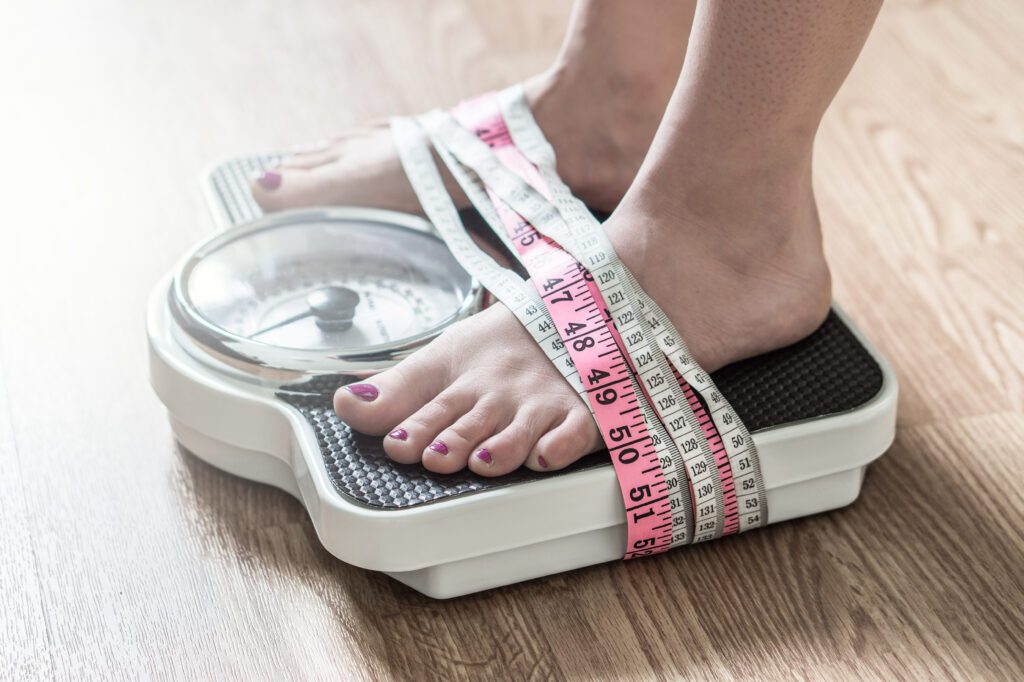
Weight Gain in Eating Disorder Recovery Is Not Just Fat
Many individuals in eating disorder recovery fear that excess weight is only fat. However, eating disorders impact all body parts and functions, and as nutritional rehabilitation begins, weight restoration occurs across all those areas, too.
During weight restoration, the body rebuilds:
- Blood volume
- Bones
- Brain tissue
- Fat mass
- Fluid balance
- Glycogen stores
- Hormones
- Muscle mass
- Organ tissue
For example, studies show that reduced brain volume caused by malnutrition begins to reverse during weight gain, particularly in the early stages of treatment.⁵ Research also highlights that bone health improves with weight restoration, although it can take many months to see measurable changes.⁶
This is why it’s crucial to have weight restoration early on, as many body functions take time to heal.
While weight gain may cause some anxiety as the number on the scale goes up, that weight represents so much more than a number. Eating disorder recovery body changes mean your body is healing and repairing itself so it can perform its many different (and essential) functions.
Body Fat Increase Is Necessary for Full Recovery and Relapse Prevention
Fat tissue is not just energy storage; it is a critical endocrine organ.
Adequate body fat supports critical body functions and is required for:
- Brain function
- Fertility
- Hormone production
- Long-term weight stability
- Menstrual function
- Temperature regulation
Research shows that lower body fat percentage after weight restoration is associated with poorer weight maintenance and higher relapse risk.⁷
When your body is undernourished while living with an eating disorder, many of these vital functions are impaired, and it can have serious health consequences. Although diet culture teaches us to be scared and ashamed of body fat, it actually plays a very important role in helping support many of those important processes.
Early Weight Gain Often Shows Up in the Stomach and Trunk First
Weight gain as a whole can be anxiety-inducing in eating disorder recovery. It can be even more frustrating and scary when it all seems to happen primarily in one area.
Research consistently shows that fat distribution immediately after weight restoration tends to be more centralized in the trunk and abdomen, especially in patients with anorexia. ⁸ ⁹ ¹⁰
This is a temporary (albeit often uncomfortable) part of weight redistribution in eating disorder recovery.
Know that your body is only doing it to protect your critical organs.
All bodies are different, however, and people may gain weight and carry weight in different areas of their bodies, both initially during weight restoration, and in the months and years after.
While weight gain can be uncomfortable, remember that what’s most important is restoring your health and living a life free from your eating disorder.
The Body Redistributes Weight Over Time
While weight gain is often centralized in the stomach and trunk area, over time, that weight will likely shift throughout your body.
The early pattern of weight gain in the core and trunk areas changes as recovery continues, and your body gets out of survival mode and once again into supporting your diverse body functions as it’s healthy and nourished.
With sustained nutrition and hormonal normalization:
- Fat distribution becomes more balanced
- Metabolism stabilizes
- Muscle mass increases
Studies show that the unusual fat distribution seen shortly after weight restoration does not reflect long-term body composition; it’s a temporary part of the transition from starvation to metabolic recovery as your body works to protect your vital organs (found in your core and trunk area).¹¹
This redistribution typically occurs over several months to a year or more, depending on factors such as your rate of weight restoration, your nutritional rehabilitation journey, and more. This is also likely to happen only once your body adjusts to regular, consistent eating, your weight stabilizes, and your hormones have had a chance to recover.
Navigating Eating Disorder Recovery and Body Changes
On its own, eating disorder recovery can be an overwhelming process. Weight gain in eating disorder recovery through nutritional rehabilitation and weight restoration can add another layer of anxiety.
However, it’s important to remind yourself that your body needs to be nourished to be healthy and keep you alive and well. Weight is a number, and does not define you, your self-worth, or who you are.
If you’re ready to support your recovery or have questions about navigating your nutrition through your eating disorder healing journey, schedule an appointment with Life Cycle Nutrition.
We’re here to provide nutritional eating disorder recovery support in Omaha, Nebraska, and beyond so you can live a life of food freedom.
WORKS CITED:
- Marzola, Enrica, Jennifer A. Nasser, Sami A. Hashim, Pei-an B. Shih, and Walter H. Kaye. 2013. “Nutritional rehabilitation in anorexia nervosa: review of the literature and implications for treatment.” BMC Psychiatry 13, no. 290 (November). https://doi.org/10.1186/1471-244X-13-290.
- Persaud-Sharma, Dharam, Sayoni Saha, and Arvin W. Trippensee. 2022. Refeeding Syndrome. Treasure Island, Florida: StatPearls [Internet]. https://www.ncbi.nlm.nih.gov/books/NBK564513/.
- Le Grange, Daniel, Erin C. Accurso, James Lock, Stewart Agras, and Susan W. Bryson. 2013. “Early Weight Gain Predicts Outcome in Two Treatments for Adolescent Anorexia Nervosa.” International Journal of Eating Disorders 47, no. 2 (November): 124-129. https://doi.org/10.1002/eat.22221.
- Garber, Andrea K., Susan M. Sawyer, Neville H. Golden, Angela S. Guarda, Debra K. Katzman, Mihael R. Kohn, Daniel Le Grange, Sloane Madden, Melissa Whitelaw, and Graham W. Redgrave. 2018. “A systematic review of approaches to refeeding hospitalized patients with anorexia nervosa.” International Journal of Eating Disorders 49, no. 3 (October): 293-310. http://doi.org/10.1002/eat.22482.
- Kaufmann, Lisa-Katrin, Jürgen Hänggi, Lutz Jäncke, Volker Baur, Marco Piccirelli, Spyros Kollias, Ulrich Schnyder, Chantal Martin-Soelch, and Gabriella Milos. 2020. “Age influences structural brain restoration during weight gain therapy in anorexia nervosa.” Translational Psychiatry 10, no. 126 (May). https://doi.org/10.1038/s41398-020-0809-7.
- El Ghoch, Marwan, Davide Gatti, Simona Calugi, Ombretta Viapiana, Peola V. Bazzani, and Riccardo D. Grave. 2016. “The Association between Weight Gain/Restoration and Bone Mineral Density in Adolescents with Anorexia Nervosa: A Systematic Review.” Nutrients 8, no. 12 (November). https://doi.org/10.3390/nu8120769.
- Kim, Youngjung, Jonathan Hersch, Lindsay P. Bodell, Janet Schebendach, Tom Hildebrandt, B. T. Walsh, and Laurel E. Mayer. 2020. “The association between leptin and weight maintenance outcome in anorexia nervosa.” International Journal of Eating Disorders 54, no. 4 (November): 527-534. https://doi.org/10.1002/eat.23407.
- Mayer, Laurel, Columbia University, and The New York State Psychiatric Institute. 2003. Body Composition Changes in Anorexia Nervosa: A Review. New York, New York: Gürze Books. https://edr.iaedpfoundation.com/body-composition-changes-in-anorexia-nervosa-a-review/.
- Mayer, Laurel, B. T. Walsh, Richard N. Pierson Jr, Steven B. Heymsfield, Dympna Gallagher, Jack Wang, Michael K. Parides, et al. 2005. “Body fat redistribution after weight gain in women with anorexia nervosa.” The American Journal of Clinical Nutrition 81, no. 6 (June): 1286-1291. https://doi.org/10.1093/ajcn/81.6.1286.
- Ginspoon, S., L. Thomas, K. Miller, S. Pitts, D. Herzog, and A. Kilbanski. 2001. “Changes in regional fat redistribution and the effects of estrogen during spontaneous weight gain in women with anorexia nervosa.” The American Journal of Clinical Nutrition 73, no. 5 (May): 865-869. https://doi.org/10.1093/ajcn/73.5.865.
- El Ghoch, Marwan, Simona Calugi, Silvia Lamburghini, and Riccardo D. Grave. 2014. “Anorexia Nervosa and Body Fat Distribution: A Systematic Review.” Nutrients 6, no. 9 (September): 3895-3912. https://doi.org/10.3390/nu6093895.
- Reed, Kylie K., Ava E. Silverman, Afrouz Abbaspour, Kyle S. Burger, Cynthia M. Bulik, and Ian M. Carroll. May. “Energy expenditure during nutritional rehabilitation: a scoping review to investigate hypermetabolism in individuals with anorexia nervosa.” Journal of Eating Disorders 12, no. 63 (21). https://doi.org/10.1186/s40337-024-01019-7.
- Kalm, Leah M., and Richard Semba. 2005. “They Starved So That Others Be Better Fed: Remembering Ancel Keys and the Minnesota Experiment.” The Journal of Nutrition 135, no. 6 (June): 1346-1352. https://doi.org/.



0 Comments