
Raising children comes with a host of challenges — and mealtimes are only one of them. Navigating the numerous mealtimes, snacktimes, and all the in-betweens can feel like climbing a mountain.
What you want most of all is for your child to be happy and healthy. But how do you know if your child is simply being a picky eater, or if it’s something more serious? How do you encourage them to eat a wide variety of foods, even when they will only eat the same handful of items? How do you ensure normal eating for children in a world of diet culture?
Helping children develop a positive relationship with food begins with you, as the parent, setting structure while also empowering them with a sense of choice about how much they want to eat, and even whether or not they want to eat at all.
Normal Eating for Children: How Does it Look?
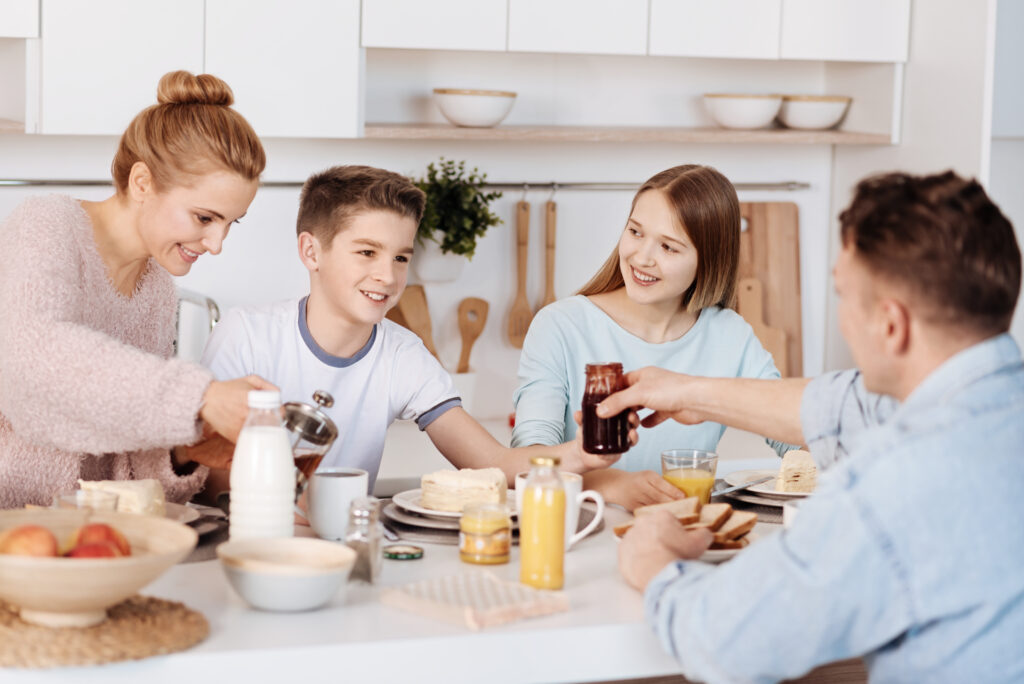
Children are, by nature, intuitive eaters. Their bodies do an incredible job of telling them whether or not they are hungry, what they want to eat, and exactly how much they need to nourish their bodies.
While young children need the most support in preparing their food, they naturally develop and want more autonomy as they get older.
Ellyn Satter’s Division of Responsibility with Feeding is a great guide that outlines what parents should know to provide nutritional support for children of all ages.¹
- What: Food prepared for the child
- When: Mealtimes and snacktimes
- Where: At the table, at a restaurant, in the car, etc.
- How Much: Portion sizes (Note that food waste is normal as children navigate hunger and fullness cues with portioned food. Kids know best when they are full and want to stop eating.)
- Whether: Children may or may not want to eat!
For example, with infants, the parent needs to prepare all meals for the child (the “what”), but the child will give strong indicators of when, where, how much, and whether they want and need to be fed.
Age-Appropriate Feeding in Children by Years
Naturally, children will have preferences and favorite foods—we all do! However, it’s not normal for a child to plan or prepare all their own meals, eat something completely different than the family, or always eat by themselves.
Here is a guide of age-appropriate eating responsibilities for children, and how that “what, when, where, how much, and whether” guide from Ellyn Satter can look.
Toddlers (1-2 Years)
After infants, toddlers need the most structure when it comes to preparing food.
| What | The caretaker should make all meals and snacks. |
| When | Parents should be responsible for choosing when structured meal and snack times are. |
| Where | The parent decides where to have sit-down meals and snacks. |
| How Much | Children will naturally eat as much as they need. Expect food waste, as this can vary widely. |
| Whether | The child decides whether or not they want to eat. |
With toddlers, it’s important to remember that the amount they eat, and whether they do it at all, can vary greatly. It may feel very inconsistent; however, remember that children are the best intuitive eaters!
Trust the process and know that they are listening to what their bodies tell them.
Preschoolers (3-5 Years)
Preschoolers will naturally want to develop some autonomy over what they eat. However, it’s critical for parents to still provide structure. This encourages children to eat a wide variety of foods and develop healthy habits!
| What | Parents prepare all family meals with variety. Children may be able to voice some of their own snack preferences, but should still have structured support from the parent, and you should still plan to prepare them. |
| When | Parents create a pleasant mealtime setting |
| Where | The parent decides where to have sit-down meals and snacks, emphasizing a focus on eating meals together as a family. |
| How Much | Preschool-age children will naturally eat as much as they need. It’s still normal to expect food waste, as their appetites can vary. |
| Whether | The child decides whether or not they want to eat. However, you can still create structure by having them sit at the table for regular family mealtimes. |
In preschool-age children, you can emphasize building structure and routine with kids’ and family mealtimes. Prepare your child the same food you are eating, and encourage them to try it! Even if they don’t end up liking something, it’s important to still encourage variety.
School-Age (6-12 Years)
School-age children will develop a growing independence in food choices outside the home. This may come with things like deciding what they eat for lunch at school or having a snack at a friend’s house.
| What | Parents should prepare balanced family meals, and may still need to ready snacks for children. However, the child may want to start preparing snacks for themselves (grabbing an apple and cheese stick, etc.). |
| When | Parents should be responsible for choosing when structured meal and snack times are. Children can begin having some autonomy over small things like snack times, but it’s ok for parents to set boundaries so that they are not eating snacks too close to meal time. |
| Where | Encourage eating at the table as a family. |
| How Much | Children should still be fully eating in line with hunger and fullness cues. However, disordered eating behaviors can begin emerging in even school-age children, so it’s important to watch for sudden changes. |
| Whether | Allow your child to decide whether or not they want to eat; however, you can still require them to sit at the table for family meal times even if they are not eating. |
While school-age children may show a desire for increasing autonomy over their meals and snacks, they will still need daily support in nourishing themselves.
Adolescents (13-18 Years)
Adolescents will have the most autonomy over their eating habits. However, it’s important for parents to still remain aware and engaged with their children’s diets and how much they are eating.
| What | The parent provides family meals and sets an example of what a healthy diet full of variety looks like. However, the child is likely making decisions on their own for things like what to have for a snack or even some meals, like breakfast. The parent should still provide structure and be prepared to make meals to encourage a healthy relationship with food and adequate nourishment. It’s important not to restrict certain foods so that children learn to eat all foods in moderation. It is not normal for children to dictate what is served for meals or to eat something different from the rest of the family. |
| When | Caretakers should provide structure, especially with family mealtimes, while allowing some flexibility for snacks and so forth. |
| Where | Parents should encourage family meals whenever possible. Although activities and schedules can get busy during these years, it’s still beneficial to prioritize at least 3 shared meals together/week. |
| How Much | Ideally, children still listen to their hunger cues. However, it’s important to be mindful of how much your child is eating. Diet culture becomes much more prevalent during this age, so it’s still good to monitor how much they are eating to be sure they are still nourishing themselves. |
| Whether | The child decides whether or not they want to eat. However, you can still create structure by having them sit at the table for regular family mealtimes. |
Adolescents will have an increasing autonomy in planning and preparing their food. They may not want to depend on you to cook their meals and prepare all their snacks—and you likely want them to have some independence in this area, as well!
Learn how to promote holistic eating habits in teens here.
Warning Signs of Disordered Eating in Children
You might be wondering how to differentiate picky eating vs. disordered eating in a child. How do you know that their fixation on one or a few foods is a problem?
Some changes in your child’s eating habits are normal — however, if it is disordered eating, it’s crucial to catch it early. Studies have shown the positive impacts of early intervention and its role in ensuring your child returns to their normal, happy self in a life of food freedom!²
Some warning signs of disordered eating to watch for include:³
Changes in Food Preferences
Your child suddenly indicates they no longer like their former favorite foods or foods they had no problem eating before.
Refusing Certain Foods or Food Groups
While it’s normal for children to have preferences for some vegetables over others, it’s abnormal for a child to not want to eat groups of foods like sweets, carbs, etc. or foods they used to eat.
Increased Concern About Weight or Health
Diet culture is prevalent and can impact children from a very young age; however, it’s abnormal for children to be concerned about their weight or their health, aside from when they have an illness.
Counting Calories or Macros
This is never normal for a child and is distinctly a disordered behavior.
Measuring or Weighing Food
Children should eat in tune with hunger and fullness cues.
Increased Interest in Cooking and or Baking But Not Always Eating What Is Made
It’s totally normal for a child to want to experiment in the kitchen! However, if they make a treat or meal for others but refuse to eat it themselves, that is a red flag.
Click here to learn more about when to be concerned about changes in your child’s eating habits.
How to Raise a Healthy Eater: Practicing Gentle Nutrition for Kids
Children and “normal” eating habits go hand-in-hand: They are the best at listening to what their bodies want and need! However, as a parent, you should still be focused on raising a healthy eater, as the way they are raised around food can impact them for life.
To foster normal eating for children, encourage them to eat a wide variety of foods by preparing them and encouraging them to try them. Avoid labeling foods as “good” or “bad,” and don’t force them to eat when they are no longer hungry or deprive them when they still are. Feeding kids without pressure is the best way to encourage them to listen to their hunger cues, and can help develop healthy lifelong eating habits!
Additionally, gentle nutrition is one of the 10 Principles of Intuitive Eating. It encourages eating what sounds good when it sounds good, alongside providing your body with essential nutrients in a compassionate way over time. Teach your child that every meal and snack plays a role in their health—but no single one will define it.
Do not underestimate the power of setting a good example for your child, regardless of their age. Children pick up on things very easily, so it’s important to practice the healthy habits you want them to develop yourself!
Support Your Child’s Nutrition Journey
If you want help guiding your child through their nutritional journey, schedule an appointment with Life Cycle Nutrition. Our dietitians are ready to empower you to guide your child to trust themselves and enjoy a life of intuitive eating and food freedom!
Works Cited
- Satter, Ellyn. 2015. “ELLYN SATTER’S DIVISION OF RESPONSIBILITY IN FEEDING.” Ellyn Satter Institute. https://www.ellynsatterinstitute.org/wp-content/uploads/2015/08/ELLYN-SATTER%E2%80%99S-DIVISION-OF-RESPONSIBILITY-IN-FEEDING.pdf.
- Mills, Regan, Lucy Hyam, and Ulrike Schmidt. 2024. “Early intervention for eating disorders.” Current Opinion in Psychiatry 37, no. 6 (September): 397-403. https://doi.org/10.1097/YCO.0000000000000963.
- “Eating Disorders in Children and Adolescents.” n.d. Johns Hopkins Medicine. Accessed September 17, 2025. https://www.hopkinsmedicine.org/health/conditions-and-diseases/eating-disorders/eating-disorders-in-children-and-adolescents.


0 Comments